
In order to achieve energy-saving purposes, the design of automobile cover parts has become increasingly lightweight, and high-strength ultra-thin steel plates have been widely used in forming. In order to evaluate the change of rigidity caused by thinning of steel plates, an anti-concave index has been proposed. The so-called anti-concave property refers to the ability of the member to withstand the lateral concentrated load against the depression, which includes: local depression resistance and anti-concave rigidity.
The test evaluates the concave resistance of the specific test piece simulation cover, and provides repeatable and comparable anti-concave test results under quasi-static (low speed) and dynamic (high speed) press-in conditions, providing a basis for part selection.
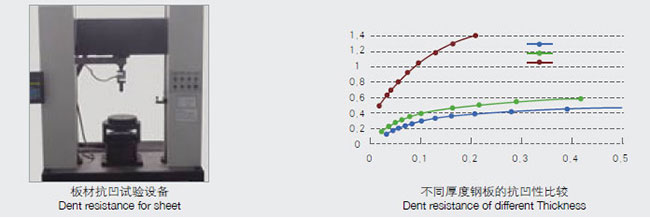
Example of evaluation of sheet surface anti-concavity: As can be seen from the above figure, the thickness increases and the local depression resistance increases.
Increased yield strength and increased local depression resistance
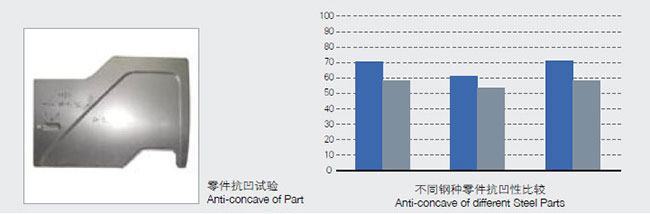
The part's anti-concavity test evaluates the concave resistance of the cover, and provides repeatable and comparable anti-concave test results under quasi-static (low speed) and dynamic (high speed) press-in conditions to evaluate the performance of the part after forming.
Telephone:021-56570699
Phone:13122206066
E-mail:qz001@qzdtc.com
Website:www.qzdtc.com
Address:Building 7, No. 748, Erqiao Village, Fengxian Town, Fengxian District, Shanghai
©Copyright 2015. qzdtc.com All Rights Reserved. QZDTC.


021-56570699


